VP Cybersecurity Strategy
Link11 GmbH
Dealing with all things security.
Security engineering leadership for regulated businesses — cloud security, detection and incident response, and DevSecOps, under NIS2, DORA, BaFin BAIT and ISO 27001. I've built security functions from the first hire, and been the one accountable when they had to hold up to a regulator.
Security looks like a cost center because it lets itself.
Most security leaders complain the executive team doesn’t see the value. That’s their failure, not the executive team’s. A good security function is operational excellence — time, money and depth defended every day, mostly invisible. Management isn’t paid to go looking for invisible work. They’re paid to ask one question: did we win?
If you have the operational depth and you’re still read as cost, that’s a visibility problem, not a value problem. Name the IR playbook your engineer wrote and what it now blocks in two minutes, automatically. Ship a monthly defensive-uplift report. Make the whole crew visible — not just whoever ran the playbook at eleven on a Sunday night.
Compliance is hygiene or it’s theater. There’s no middle.
Paper compliance looks like 99 of 100 boxes ticked. Then someone goes a layer deeper into access management and finds four teams granting permissions four different ways, none of which match the process written up for the auditor. The policy passed. The practice never changed.
It takes technical depth to find the four silos and a leader willing to pick a fight with all four to fix them. The path of least resistance is to write the policy, pass the audit and call it done — which teaches management exactly the wrong lesson: the first certification was cheap, so the next one will be too. That paper compliance was worse than none arrives with the incident. That’s the bill.
AI in defense rewards the curious.
Good security minds are paranoid. Great ones are paranoid, curious and willing to tinker. AI is the shift that shows which kind you have.
We’ve seen this before. We were paranoid about cloud and wanted the perimeter back. That stance lost — cloud security got rebuilt around the new shape. AI is moving faster, and the headcount excuse is gone: nothing stops a security team from standing up agents and deterministic automation against the backlog except the willingness to learn.
The curious will shape how AI security gets done. The rest will still be drafting the policy that says you can’t use it.
Dealing with all things security.
Joined as first security hire; left leading a combined 16 across Security, IT, and Cloud Infrastructure & DevOps. Initiated and led the firm's DORA readiness programme as it moved off a tied-agent model toward direct BaFin supervision under the WpIG. ISO 27001 in 2024, posture improved 300%, AWS spend cut 50%+ via architectural redesign as cost-centre owner, and a company-wide AI governance programme.
Investigated and mitigated the Codecov supply-chain incident (among others), earning company-wide recognition for response quality. Shipped Python/Docker/Terraform tooling that reshaped forensic speed, and built a custom vulnerability management CLI integrating Jira + GitHub across 1,000+ repos.
Wrote IaC — Ansible, Terraform, CloudFormation, Packer — to deliver security-hardened AWS infrastructure for an enterprise e-commerce PaaS. Built deployment pipelines with health checks, security rulesets, and guardrails embedded directly as code.
Worked 24/7 SOC floors. Engineered detection playbooks and SIEM correlation rules against MITRE ATT&CK for IOC hunting and anomaly detection. Embedded as resident security engineer for core clients — built custom AWS monitoring on CloudTrail, VPC Flow Logs, and GuardDuty that became backbone infrastructure at Careem/Uber MEA.
Where hands-on network security — pfSense, Untangle, L0phtCrack, John the Ripper — pulled me out of traditional dev and into cyber for good.
A supply-chain incident is a leadership test before it's a technical one. You can run the IR perfectly and still fail on communication.
First as the on-call engineer responding to Codecov at HelloFresh. Later as CISO at Moonfare, coordinating response to a third-party breach that created potential exposure on our side. Different technical profiles, same operational problem: scan fast, scope impact accurately, brief the board honestly, don’t let the noise derail the business.
Supply chain is the most under-rated part of the threat model — and the hardest to run well when everyone is already tired.
Every control had to earn its place before it went in. I wanted a function that moved the business, not one that reacted to it.
The first call was what to rent and what to own. Detection started from zero: no SIEM, no EDR. An MSSP ran the SIEM setup and L1 triage at first, which freed the engineers I hired for hardening, vulnerability management, IAM and policy. Rule tuning, L2 analysis and incident response stayed in-house from day one, with the rules tested in purple-team exercises, and once the team matured we dropped the MSSP and took triage in-house too. The second call was to grow mid-level engineers on both the red and blue sides rather than hiring a senior into every seat.
The artifact I’m proudest of isn’t a tool. It’s the monthly report that put security in language the rest of the company could actually read.
Careem became my employer's client after a security incident. I got loaned out to build their detection capability from scratch.
Set up detection, ran cloud security posture analysis across 50+ AWS accounts, and built the CloudTrail rules and detection logic that became the backbone of their SOC. Ran incident investigations and on-site network pentests out of their Karachi office.
Being embedded teaches you what an MSSP seat can’t: security as something that happens inside someone else’s business, on their clock, with their priorities on your shoulders. Most of what I know about CISO-side tradeoffs started there.
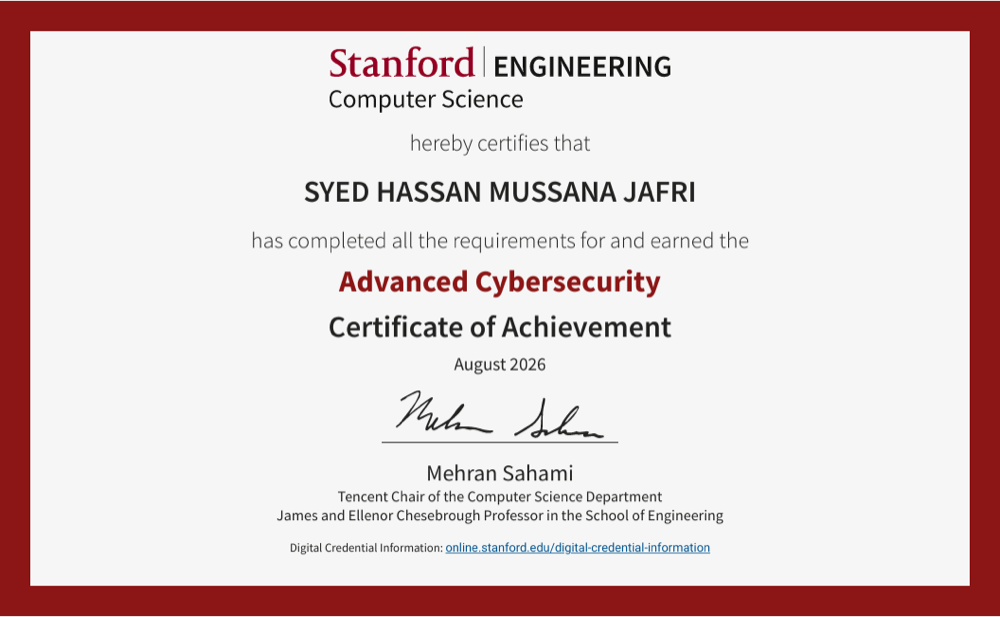
Advanced Cybersecurity Certificate of Achievement
Five courses, 60+ hours: Foundations of Information Security; Using Cryptography Correctly (XACS130); Exploiting and Protecting Web Applications (XACS133); Cloud Security (XACS235); Network Security (XACS255) — taught by Dan Boneh, John Mitchell and Neil Daswani.
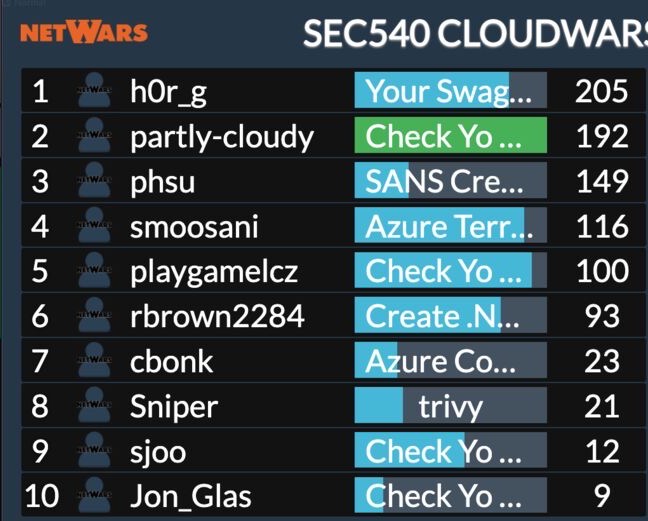
I won the Cloudwars Challenge Coin — the SEC540 capstone, scored live against the rest of the class on attacking and defending a cloud-native pipeline.

What makes me credible in a boardroom.
What keeps me honest in engineering conversations.
Badges verifiable on Credly.
B.E., Computer Software Engineering
National University of Sciences & Technology (NUST), Islamabad · 2011–2015